Trump Trade War Diary — Day 374
On Aircraft and the Art of Regulatory Retaliation
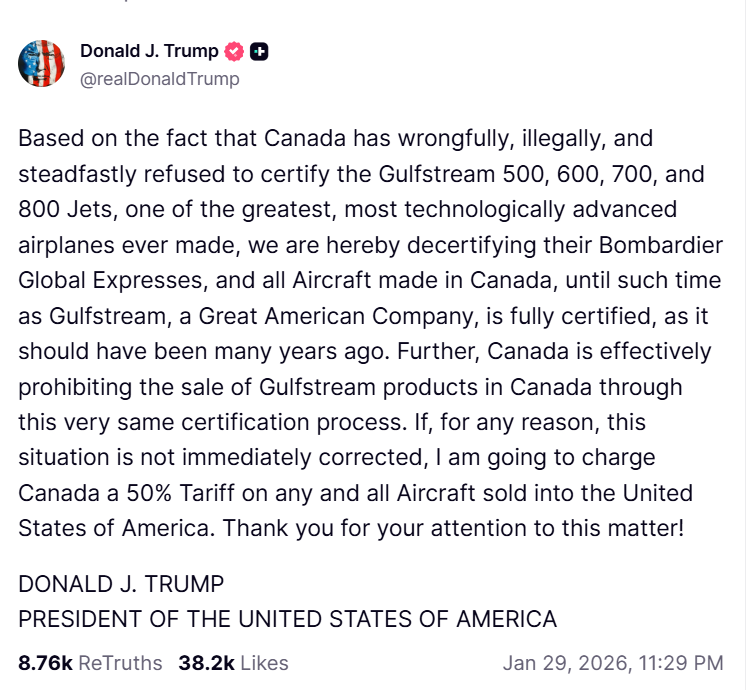
The US has announced it will decertify Bombardier aircraft and threatens 50% tariffs on all Canadian planes—unless Canada certifies Gulfstream jets “immediately.” This is a notable shift in trade war tactics. The blunt universal tariff—the economic equivalent of shouting at weather—has given way to something more precise: weaponised certification. The framing is instructive. Canada’s certification process isn’t “illegal”; it’s simply Canadian. Different country, different timeline. This has been true since approximately the invention of countries. But by presenting decertification as response rather than aggression, Washington shifts the narrative.
Why aircraft? Bombardier is a crown jewel of Canadian manufacturing, politically impossible to abandon. Meanwhile, Canada has been diversifying trade toward the EU and Asia—reducing its dependence on US markets. Targeting aerospace sends a clear message: alternatives have costs. The deeper problem is that using safety certification as a trade weapon rather undermines the concept of mutual recognition that makes international aviation function. If every country’s airworthiness decisions become bargaining chips, we end up with planes certified to fly everywhere except the places they need to go.
Somewhere in Toulouse, Airbus executives are watching with the quiet satisfaction of people who didn’t start the fire but remembered to bring marshmallows.