Trump Trade War Diary — Day 189
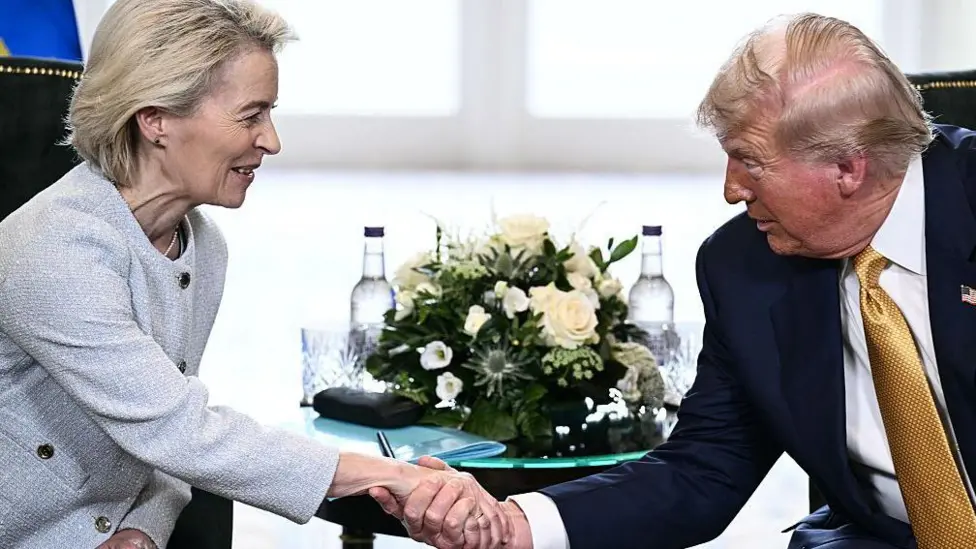
Trump travelled to Scotland to play golf in his 2 resorts, Trump Turnberry and Trump Aberdeen. He also met with Ursula von der Leyen, the President of the European Commission, to discuss the ongoing trade tensions between the US and the EU. The meeting was seen as an opportunity to de-escalate the situation, especially after Trump’s recent threats of a 30% tariff on EU imports.
The result of the meeting was an agreement between the EU and US. Here are main points of the agreement:
Trump and von der Leyen Strike Trade Deal: A 15% Tariff “Victory” That Nobody Really Wanted
The EU secures what it’s calling a win by agreeing to pay significantly more for the privilege of trading with its largest partner
In what both sides are diplomatically terming a “breakthrough,” European Commission President Ursula von der Leyen and US President Donald Trump announced a trade agreement on Sunday that imposes 15% tariffs on most EU exports to America. The deal, struck at Trump’s Scottish golf resort after what von der Leyen described as “tough negotiations,” successfully averted the threatened 30% tariffs while introducing the highest systematic trade barriers between the transatlantic partners since the 1930s.
Recent research from Aston University’s Centre for Business Prosperity provides sobering context for this “victory.” In their comprehensive analysis “Tariffs and Triumph: The UK’s Edge in a Fractured World,” economists Jun Du and Oleksandr Shepotylo project that Trump’s broader tariff agenda could trigger a $1.4 trillion global welfare loss under full retaliation scenarios. Their structural gravity modeling across six escalation scenarios reveals that while some countries may benefit temporarily from trade diversion, “no economy emerges unscathed from systemic tariff escalations.”
The EU-US deal represents a step back from the precipice, but hardly a return to normalcy. As the Aston research warns, we are “slowly moving away from trade war, but not nearly there yet”—a reality underscored by the fact that this “compromise” still constitutes the most significant peacetime trade restriction between allies in nearly a century.
The Art of the Deal: Paying More to Lose Less
Trump, never one for understatement, declared the agreement “probably the biggest deal ever reached in any capacity, trade or beyond trade.” The terms suggest the EU has indeed made it big—just not in the way Brussels originally envisioned when negotiations began with hopes for a “zero-for-zero” tariff arrangement.
Under the new framework, European exporters will pay 15% to access the American market while simultaneously committing to purchase $750 billion worth of US energy, invest an additional $600 billion in America, and buy “hundreds of billions of dollars” worth of American military equipment. In exchange, Trump promised “zero tariff” access to EU markets—a concession that sounds more generous than it likely is, given existing EU trade policies.
A Relative Victory in Difficult Times
For European officials, the 15% rate represents something of a pyrrhic victory. While significantly higher than the pre-negotiation baseline, it positions the EU more favorably than other trading partners who have faced Trump’s “reciprocal tariffs” regime. The bloc can reasonably argue it secured better terms than many nations, making this a relative win in Trump’s new trade order.
More importantly for European strategic thinking, the deal implicitly reinforces broader transatlantic ties at a time when the EU desperately needs American military commitment. The massive defense purchases serve dual purposes: satisfying Trump’s transactional approach while strengthening NATO capabilities and maintaining US support for Ukraine against Russian aggression. European leaders clearly calculated that preserving American security guarantees was worth paying premium trade terms.
Historical Context: Back to the Future
What both sides are politely not mentioning is that this agreement represents the most significant increase in systematic trade barriers between the US and EU since the protectionist surge of the 1930s. The 15% baseline tariff, while lower than Trump’s threats, still constitutes an unprecedented peacetime trade restriction between allies who have spent decades promoting free trade principles.
The steel and aluminum sectors face even steeper challenges, with their 50% tariffs remaining unchanged—a detail that underscores how selective this “comprehensive” deal actually is.
The Trump Uncertainty Principle
Perhaps the most sobering aspect of Sunday’s agreement is how contingent it remains on the whims of a notoriously unpredictable president. Trump’s track record suggests that trade deals, like other international agreements, can be reconsidered, renegotiated, or abandoned based on his shifting priorities or Twitter moods.
As one unnamed EU diplomat noted, trading partners consistently worry about “future American levies on sectors including pharmaceuticals, semiconductors, and aerospace,” regardless of current agreements. This reflects the new reality of Trump’s trade policy: even successful negotiations merely pause the uncertainty rather than resolve it.
Rebalancing Reality
Von der Leyen’s acknowledgment that the EU’s €200 billion trade surplus “needs to be rebalanced” marked a significant rhetorical shift from Brussels’ traditional free-trade stance. Her concession that previous arrangements were problematic provided Trump with the political cover he needed while giving European negotiators something concrete to offer.
The trade imbalance was real, but the solution—essentially paying protection money for market access—represents a fundamental departure from how democratic allies typically resolve commercial disputes.
What Happens Next
The framework agreement leaves numerous details unresolved, ensuring months of additional technical negotiations. European businesses now face the challenge of adapting to the new tariff reality while hoping the current terms don’t deteriorate further.
For other US trading partners watching from the sidelines, the EU deal provides both reassurance and warning: accommodating Trump’s demands may yield manageable outcomes, but the price of doing business with America has fundamentally changed.
Trump’s approach has successfully forced even America’s closest allies into accepting what previous administrations would have considered unthinkable trade restrictions. Whether this represents sustainable policy or merely the calm before another storm remains the trillion-dollar question that no handshake in Scotland can definitively answer.
The EU got its deal, Trump got his tariffs, and both sides avoided immediate catastrophe. In the current international environment, perhaps that counts as victory enough.